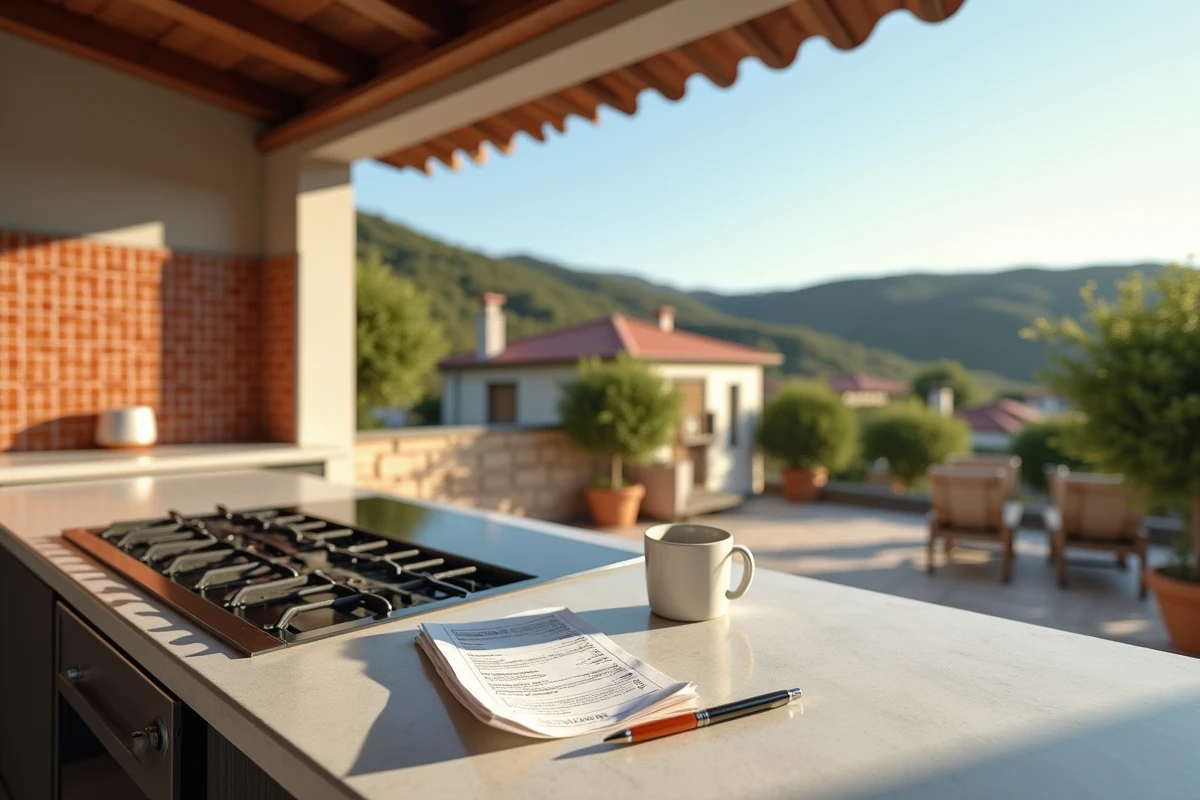
An outdoor kitchen that is fixed to the ground, covered, and connected to utilities can change the rental cadastral value of a property. The property tax, development tax, and, in some cases, the housing tax on second homes are directly affected. Understanding the criteria that trigger taxation helps avoid unpleasant surprises when receiving a tax notice.
Outdoor Kitchen and Cadastral Rental Value: The Closed Building Criterion
The tax authorities do not tax a barbecue placed on a terrace. The trigger is the qualification of the installation as a covered building fixed to the ground permanently. The DGFiP specifies in its practical brochure Local Taxes 2024 that the liability for property tax on built properties is based on this notion.
In practical terms, an open-sided summer kitchen, even if built with masonry, generally escapes property tax. It does not constitute a taxable outbuilding as long as it remains without side closures. The situation changes when walls, glass doors, or partitions transform the space into a room comparable to a living area.
The question of taxation of outdoor kitchens arises less from culinary use than from the constructive nature of the structure. A closed pool house containing a cooking area will be taxed as an outbuilding, while an open pergola with a plancha will not.

Development Tax on a Summer Kitchen: Area and Declaration Thresholds
The development tax applies to any creation of a closed and covered area exceeding five square meters. It is due at the time of the urban planning authorization, whether it is a prior declaration or a building permit.
What Triggers the Development Tax
- A covered and closed construction with a ceiling height greater than 1.80 meters, declared at the town hall, automatically generates the calculation of the development tax.
- A garden shed or a converted container serving as an outdoor kitchen falls within the scope as soon as it exceeds the area threshold, even without connection to utilities.
- A modular kitchen simply placed on the ground, without a slab or anchoring, is not considered a construction and remains outside the scope.
The flat rates per square meter used to calculate this tax are reassessed each year. The amounts applicable in 2026 show a significant increase in the cost per square meter for constructions declared as shelters, which directly affects permanent shelter kitchen projects.
Municipal Rate and Departmental Share
The final amount depends on the rate voted by the municipality and the departmental rate. Some municipalities apply a higher rate in areas under strong land pressure. Checking the current rate with the town hall’s urban planning department remains the only reliable way to estimate the actual cost before submitting the application.
Urban Planning Declaration and Impact on Property Tax: The Thresholds to Know
The authorization regime depends on the created floor area. These thresholds also condition the update of the cadastral rental value, and thus the property tax.
Any closed and covered construction modifies the substance of the property in the eyes of the cadastre. After the completion of the work, the owner has 90 days to submit a declaration to the public finance center. This declaration serves to recalculate the rental value of the property, which may lead to an increase in property tax as early as the following year.
In practice, a closed outdoor kitchen of a few square meters has a moderate impact on property tax. The increase depends on the area, the quality of materials, and the municipality. For an open kitchen that is not closed, no cadastral declaration is required since the structure does not meet the definition of a taxable building.
Housing Tax on Second Homes and Closed Outdoor Kitchen
Since the gradual abolition of the housing tax on primary residences, only the housing tax on second homes and vacant properties remains. A closed outdoor kitchen, classified as an outbuilding, may be included in the base of this tax if the property in question is a second home.
The DGFiP applies the same analysis grid as for property tax: the structure must be covered, closed, and permanently fixed to the ground. A kitchen-veranda with closing bays, attached to a vacation home, will therefore be included in the calculation. An open awning with a sink and plancha will not.
Modular Outdoor Kitchen: The Way to Avoid Taxation
Modular kitchens placed on an existing terrace, without foundation or permanent anchoring, do not create taxable area. They do not require prior declaration or building permit, and do not affect the cadastral rental value of the property.
The removable nature of the installation is the determining factor. A module on wheels, a plancha cart, or an island placed without fixation remains furniture in the fiscal sense. As soon as a slab is poured or the whole is bolted to the ground, the administration can reclassify the installation as a construction.
This distinction explains the growing popularity of modular solutions among owners eager to arrange their garden without increasing their local taxes. The choice between a fixed masonry kitchen and a removable layout is not only a matter of aesthetics or initial budget, but also impacts the amount of local taxes throughout the lifespan of the equipment.