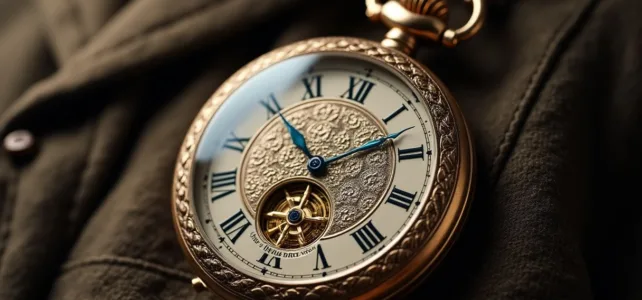
In a world where technology is advancing at a dizzying pace, some icons of the past continue to exert an irresistible allure. The pocket watch, with its timeless charm, is one of those objects. Representing both elegance and precision, it has traversed the centuries to become a symbol of a refined lifestyle.
Birth and evolution of the pocket watch
The pocket watch finds its roots in the 16th century, a time when watchmaking was an art reserved for an elite. These early watches, although rudimentary, laid the groundwork for a horological revolution that would transform the perception of time.
- Origins and early models: The first pocket watches were often worn as pendants. Designed primarily for the nobility, they were true works of art, meticulously decorated with intricate engravings.
- The Age of Enlightenment and the rise of watchmaking: This period saw the advent of more sophisticated mechanisms, making pocket watches more accurate and accessible to a wider clientele, notably thanks to the innovation of the anchor escapement.
- The industrial era and standardization: The 19th century marked a turning point with mass production, making the pocket watch accessible to the middle class. Styles diversified, incorporating materials like metal and gold, while maintaining an elegant appearance.
A precision mechanism: the art of the pocket watch
Each pocket watch is a statement of technical ingenuity, a harmonious dance of gears and springs. Understanding its operation is to enter the secret world of micromechanics.
- The beating heart, the movement: At the center of each watch, the mechanical movement, like a horological symphony, ensures the uninterrupted counting of seconds. Manual movements require regular winding, reminding the user of their daily ritual.
- The mechanical complications: Beyond displaying the time, some watches incorporate complications such as the moon phase or chronograph, adding an aesthetic and functional dimension.
- The tourbillon: A complex device that compensates for the effects of gravity on timekeeping accuracy.
- The minute repeater: Allows the announcement of the time through sounds, a fascinating technical feat.
The pocket watch in contemporary fashion
Although relegated by some to the status of a relic of the past, the pocket watch is reinventing itself, finding its place in the realm of modern fashion. It embodies a tangible link between ancient traditions and current trends.
A timeless style accessory: For vintage enthusiasts, the pocket watch represents a bold choice. Worn with a delicately wrapped chain around a buttonhole, it becomes a focal point of elegance.
- Men’s fashion: Pair it with a three-piece suit for a dandy look, blending tradition and modernity.
- Women’s fashion: Integrate it into a retro outfit, offering a charming juxtaposition of softness and sophistication.
Symbolism and heritage of the pocket watch
Beyond its primary utility, the pocket watch carries a strong symbolic meaning, transmitting essential values through generations.
- A family heirloom: Often passed down from generation to generation, these watches become silent witnesses to family history, laden with memories and emotions.
- A status emblem: Throughout the ages, it has often been used as a symbol of prestige and status, reflecting the taste and wealth of its owner.
- A symbolic dimension: Worn on special occasions, such as weddings or ceremonies, it embodies an unbreakable link with the past while opening a window to the future.